
The sign industry has largely moved from neon and fluorescent illumination to LEDs over the past couple of decades, driven by a series of efficiency gains in the technology itself. That same shift is opening the door to another one: solar and wind power becoming practical ways to run an illuminated sign, rather than running conventional electrical service to it.
We've developed customized solar pylon components in this space, working with renewable energy system integrators as well as sign companies on these installations. Two challenges come up consistently, especially in northern climates: harsh winter conditions, and making sure the solar panel or wind turbine doesn't end up overshadowing the sign it's meant to power.
How Solar Power Works for a Sign
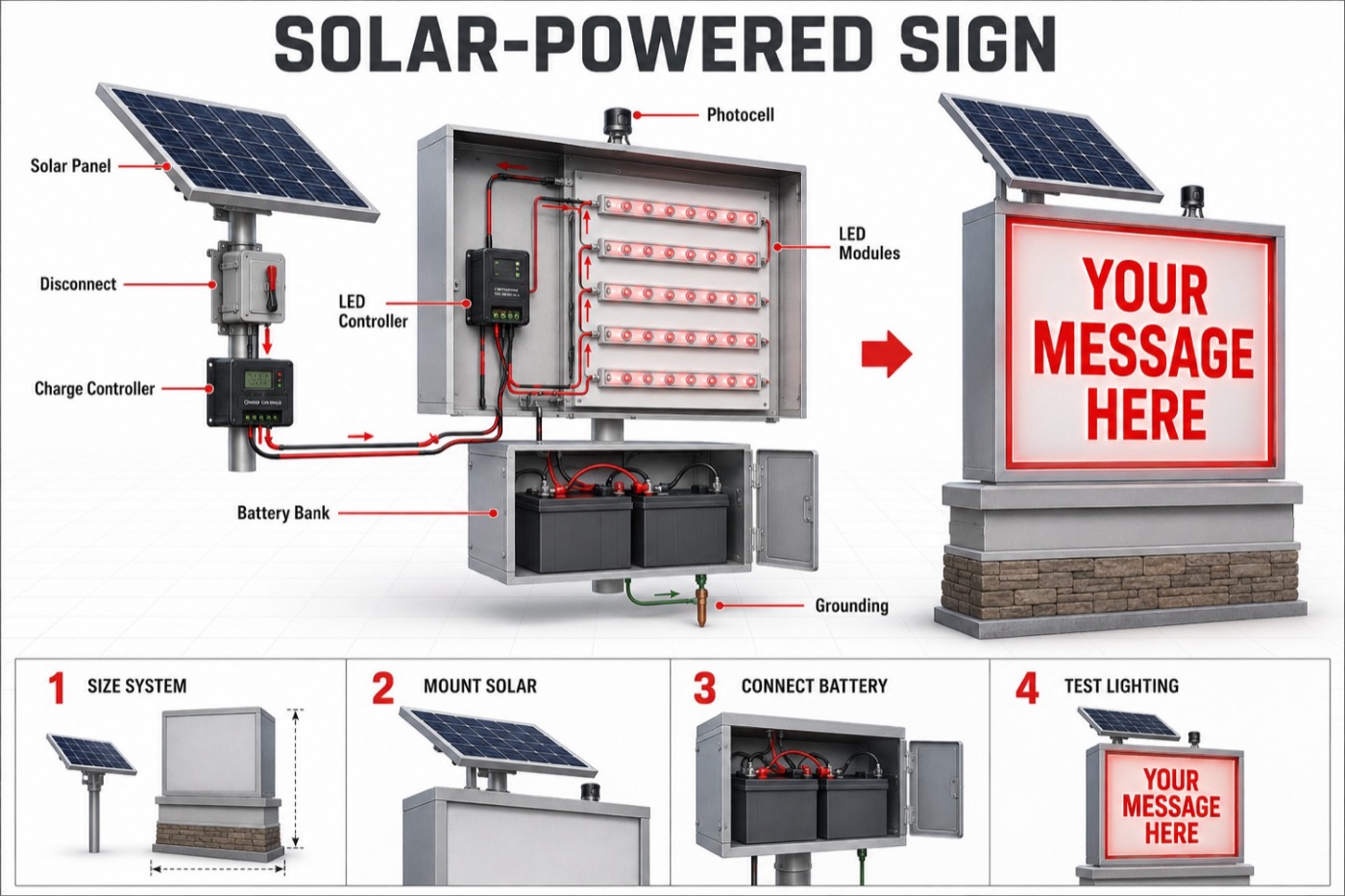
A solar power system uses sunlight to generate direct current (DC) electricity, at the same voltages a typical battery runs on. Three components do the work: a solar panel, a charge controller, and a battery. The panel charges the battery during the day; the battery then supplies the DC voltage an LED sign needs to run, typically 12V or 24V, after dark.
This is different from the AC (alternating current) solar systems most renewable energy suppliers are more familiar with — the kind connected to a home or farm's power line, sometimes with a utility rebate for feeding energy back into the grid. A sign system doesn't feed back into anything. It needs its own battery bank sized to run the sign through the night, every night.
Wind Power for a Sign
A small wind-powered generator charges a battery bank the same way a solar panel does, and can power a sign through the same basic setup. One practical difference: unlike a solar panel, a wind turbine's housing can be finished to coordinate with the sign's colors as part of the structure, rather than reading as a separate add-on.
Hybrid Systems
Solar and wind are also combined into a single hybrid system, which produces more power than either alone and holds up better across changing weather through the year — wind on an overcast day, solar on a clear one, and both on a day that's sunny and windy. For a sign that needs to stay lit around the clock, or one installed somewhere prone to shifting conditions, a hybrid system is often the more reliable choice.
System Components
Solar and wind systems share most of the same hardware: the panel or turbine, a power management controller/charger, batteries in a weatherproof enclosure, and outdoor-rated cabling and connectors. Because these systems are built for outdoor use, components are rated for a wide temperature range — roughly -20°C to +60°C (-4°F to +140°F) is typical. Panel and turbine size matters too; smaller components are available now specifically so the power system doesn't visually compete with the sign itself.
Benefits Beyond the Environmental Case
Renewable power gets adopted for environmental reasons first, but it solves some practical problems too. Generating electricity at the sign site removes the need for trenching, field wiring, or a licensed electrician to bring conventional service to the location — which lowers installation cost, opens up more flexible sign placement, and can shorten the permitting process. Long-term maintenance tends to be simpler as well.
It also opens a business line some sign shops haven't considered: the same components and expertise apply to municipal parking-lot lighting and similar off-grid systems. And depending on federal, provincial, or municipal rules where the sign is installed, the cost of the solar or wind system itself may be tax-deductible — worth checking with a tax professional rather than assuming either way.
What Affects the Design
Solar and wind technology keeps improving, so it's worth working with suppliers who understand the sign industry specifically — off-grid DC systems, LED power consumption, small-scale components, and the UL 48 and CSA C22.2 No. 207 requirements that apply to illuminated signs, not just general electrical work.
A few things shape the actual system design on any given project:
- Geographic location. How much usable sun or wind is available across the year determines battery capacity and, for solar specifically, whether the site needs an internet-connected dimmer to conserve power through low-light stretches.
- Sign size and configuration. A single-faced sign draws differently than a double-, triple-, or four-sided one, and that changes the system's power budget.
- Mounting and orientation. Panels can go on top of, behind, or beside the sign depending on visibility and sun angle, and which direction the sign faces — north, south, east, or west — affects how much of the day it's actually generating.
- Indoor vs. outdoor components. For a sign mounted on a building, either indoor or outdoor-rated chargers, controllers, and batteries can work, depending on where they're located.
- Operating hours. How long the sign needs to stay lit each day is a direct input into how much storage the battery bank needs.
Some of this is now handled remotely: cloud-connected controllers let a sign shop or its customer monitor system health from anywhere, and adjust the LED dimmer's summer and winter profiles to conserve power as daylight hours change. A sun-tracking mount is another option worth considering on solar installations specifically, to keep the panel angled for peak output through the day.
None of this replaces good judgment on the fundamentals — a well-designed system still comes down to matching the sign's actual power draw to what the site can realistically generate and store, then building in enough margin for the worst stretch of weather the location sees in a normal year.
Renewable Energy for Signs FAQ
How does a solar-powered sign work at night?
The solar panel charges a battery bank during the day through a charge controller. After dusk, the battery supplies DC power to the sign's LEDs, typically at 12V or 24V, on a timer or photocell.
Can wind power alone run an illuminated sign?
Yes. A small wind generator can charge a battery bank the same way a solar panel does. Wind and solar are also commonly combined into a hybrid system, so the sign draws from whichever source is producing on a given day.
What should be considered before specifying a renewable-powered sign?
Geographic location and sun or wind exposure, the sign's dimensions and number of illuminated faces, panel or turbine orientation, battery capacity for cloudy weather and shorter winter days, and whether the system needs remote monitoring all factor into the design.
We manufacture solar-powered signs and pylon and monument signs for sign companies across the United States and Canada, including customized solar pylon components for renewable energy system integrators. Project specifics — sign size, location, and power requirements — should be confirmed before a system is designed.