Ask a few people in the sign business what "UL certified" means and you'll get a few different answers. A UL 48 sign, a UL Recognized part, a cULus power supply, and a CSA-marked sign all sit under the same umbrella, but each one says something different about what was actually evaluated. Mixing them up is how a job ends up with paperwork that doesn't match the product.
Here's how the pieces fit together, and what we'd check before you place an order.
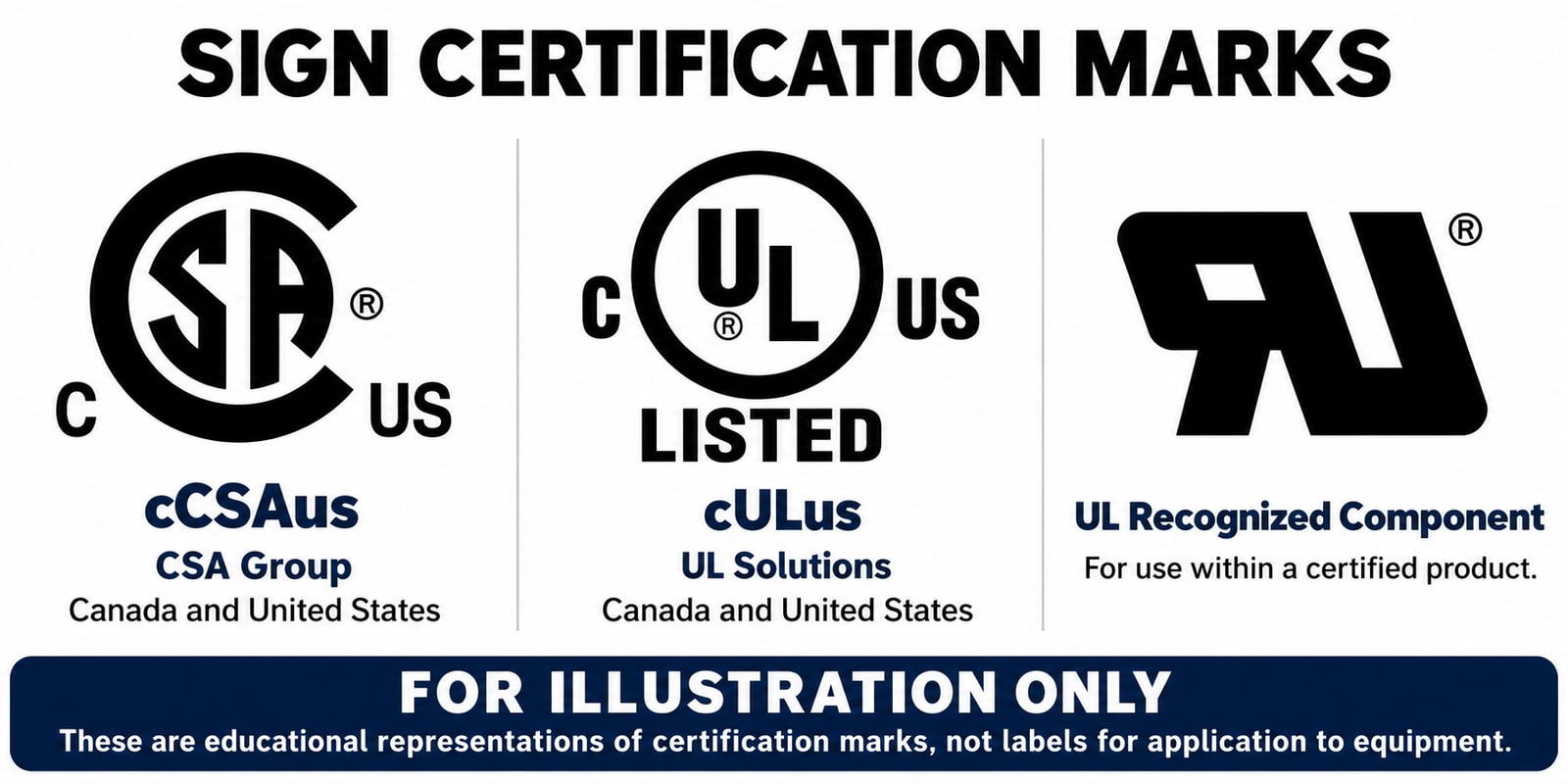
The marks are shown for illustration only. Always check the real label and the certification record for the product in front of you.
What UL 48 Covers
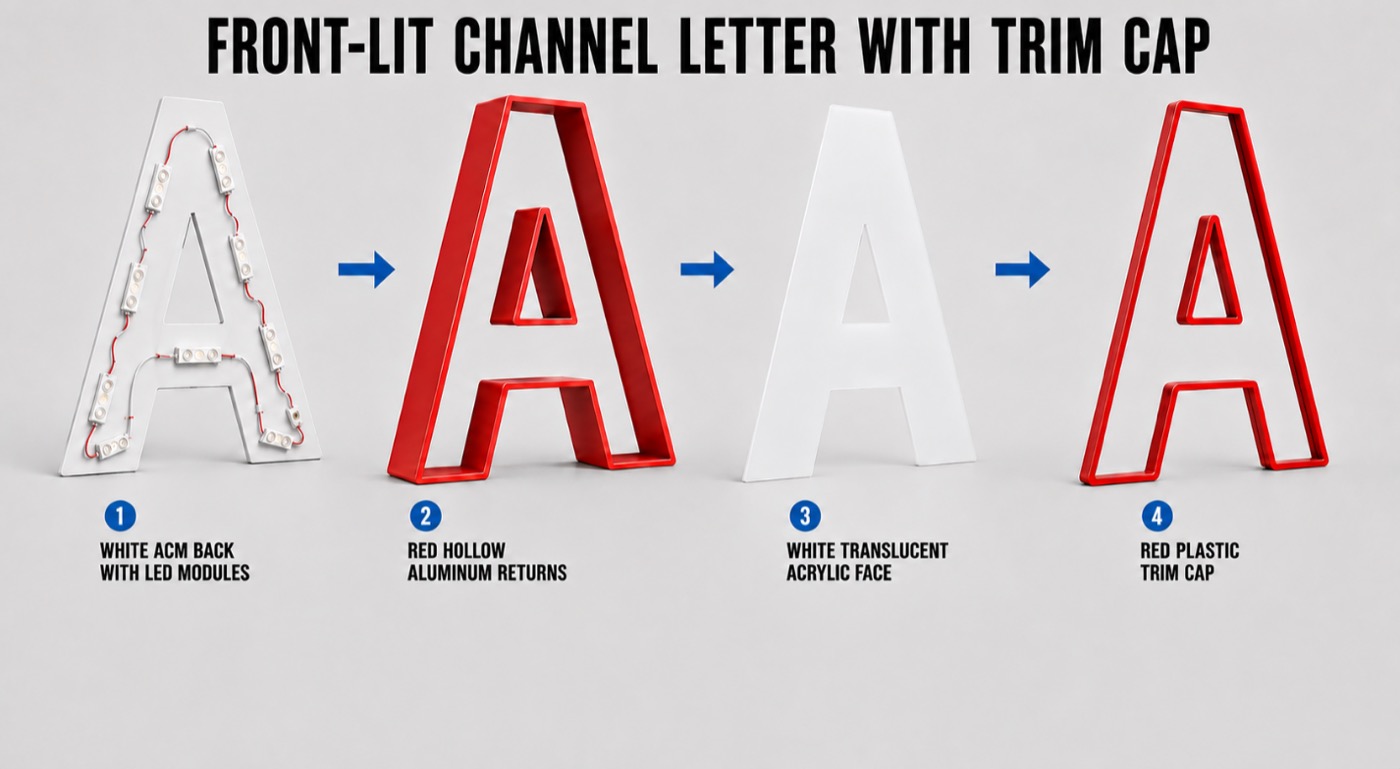
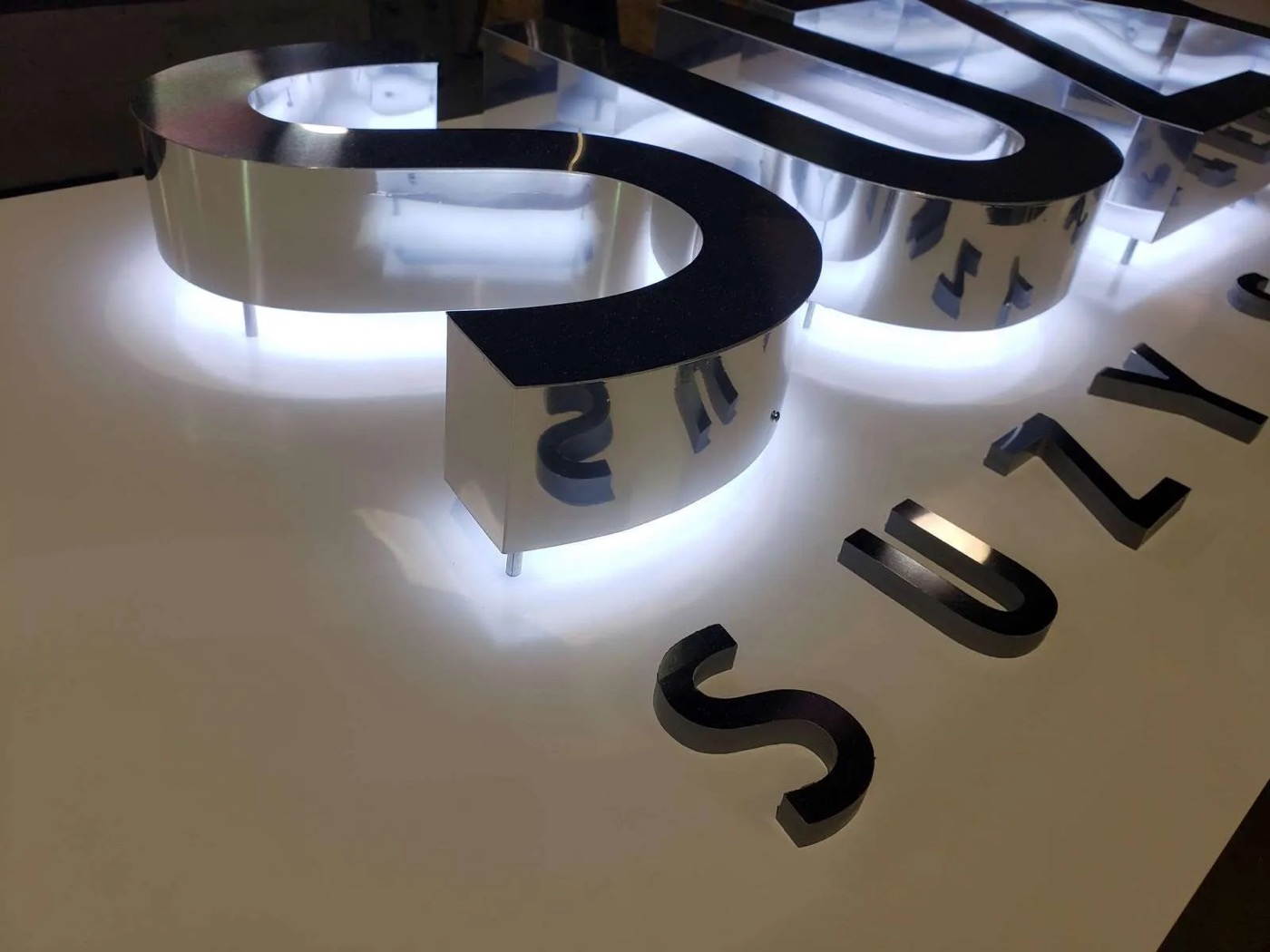
UL 48 is the Standard for Electric Signs. It sets safety requirements for electrically operated or illuminated signs, including channel letters, sign cabinets, electronic displays, and outline lighting. What it evaluates is the assembled sign, not just the LEDs or the power supply inside it.
For a manufacturer, meeting it means dealing with enclosure construction, wiring, grounding and bonding, protection against electric shock and fire, suitability for the environment, markings, and installation instructions.
UL's General Coverage program lets participating manufacturers build custom signs within set requirements, including signs for dry, damp, or wet locations. The manufacturer has to follow its authorized certification procedure and the follow-up requirements before it can apply a UL certification label. That's the key point: using certified components doesn't, on its own, make the finished sign UL Listed. For more on the standard itself, see our guide to UL requirements for illuminated signs in the United States.
The Standards and What Each One Does
| Reference | Role in Sign Manufacturing |
|---|---|
| UL 48 | Safety requirements for the completed electric sign |
| UL 879 | Safety requirements for electric sign components |
| UL 879A | Requirements for LED sign and sign retrofit kits |
| Sign Components Manual and database | Component selection information and conditions of use. It's a reference tool, not a separate safety standard |
Which component standard applies depends on the product category. Not every material, wire, connector, or power supply in a sign is evaluated under UL 879.
How the Sign Components Manual Is Used
The Sign Components Manual, usually called SAM, lists components and explains how they may be used in certified signs. UL now provides that information through its online Sign Components database. Finding a part in the database doesn't authorize it for every sign design. The listing has to be read alongside the sign manufacturer's follow-up service procedure, UL 48, the follow-up instructions, the component's installation instructions, and its stated conditions of use. UL may still need to evaluate a particular construction.
Before a component goes into a sign, a shop should check the following:
| Check | What to Verify |
|---|---|
| Manufacturer and model | The exact product received matches the certification record |
| File and product category | The certification status, intended application, and applicable standard |
| Electrical and thermal ratings | Voltage, current, loading, and temperature limits |
| Environment | Suitability for dry, damp, or wet locations and any required protection |
| Conditions of use | Mounting, enclosure, spacing, and other restrictions |
| Country coverage | U.S., Canadian, or dual-country coverage, as the job requires |
UL Listed and UL Recognized
Both marks come from UL, and they mean different things. The backward RU symbol is the UL Recognized Component mark. Recognition means the part has been evaluated for use inside another product, subject to limits called Conditions of Acceptability. The finished assembly has to satisfy those conditions. Our article on UL Listed vs. UL Recognized goes deeper on the most common mistakes.
| Designation | What It Means for a Sign Shop |
|---|---|
| UL Listed | A product evaluated for its specified end use. A completed sign must carry its own authorized certification label |
| UL Recognized component | A part meant to be built into other equipment. Recognition doesn't certify the complete sign |
| cUL | UL certification covering Canadian requirements. Check the actual certification record |
| cULus | UL certification covering both Canadian and U.S. requirements. Check the scope and ratings |
UL issues Recognized Component marks for the United States, for Canada, and for both countries, so U.S.-only recognition doesn't automatically establish Canadian coverage.
The Canadian Counterpart to UL 48
CSA C22.2 No. 207, Portable and stationary electric signs and displays, plays the same role in Canada. It shouldn't be treated as identical to UL 48, and it isn't automatic reciprocal approval.
| Purpose | United States | Canada |
|---|---|---|
| Safety of the manufactured sign | UL 48 | CSA C22.2 No. 207 |
| Electrical installation | NFPA 70 National Electrical Code, especially Article 600 | Canadian Electrical Code, especially Section 34, as adopted locally |
CSA writes standards and also certifies products, and the two are separate matters. The standard number is one thing and the certification mark is another, so UL can certify a sign to the applicable Canadian requirements. What counts is that the certification covers the destination market and that the installation meets the locally adopted electrical code and the local authority's requirements. Our guide to CSA requirements for illuminated signs in Canada covers the Canadian side in detail.
Are cULus and cCSAus Equivalent?
Generally, yes, for the same purpose. When two marks cover the same product, the applicable standards, and the intended use, they serve an equivalent safety certification role. The cULus mark is issued by UL. The cCSAus mark is issued by CSA. Both indicate certification covering Canada and the United States, and the marks identify the certification body and the geographic coverage, not a single universal product standard.
| Mark | Certification Body | Markets Covered |
|---|---|---|
| cULus | UL | Canada and the United States |
| cCSAus | CSA | Canada and the United States |
For a completed electric sign, verify certification to UL 48 for the United States and to CSA C22.2 No. 207 for Canada. A CSA-certified sign that covers those standards generally serves the same approval purpose as a UL-certified sign that covers them. Still check the certification record, the product scope, and any project or local authority requirements, since the local inspector has the final word.
Components are different. Dual-country coverage doesn't make two parts interchangeable, so before you replace a cULus part with a cCSAus one, confirm the exact model, ratings, conditions of use, and that it's acceptable under the certification procedure covering the sign. Neither component mark certifies the finished sign.
What to Specify When You Order
For components, provide the exact model, the certification file number, the applicable standard, the U.S. and Canadian coverage, the environmental ratings, the installation instructions, and the Conditions of Acceptability for use in electric signs. Confirm that the part is acceptable under the sign certification procedure before anyone substitutes it.
For completed signs, name the certification you need for the destination: UL 48 for the United States, CSA C22.2 No. 207 for Canada, or both. Ask for the authorized certification label and the installation instructions to ship with the sign.
Certification can't be added to a sign after the fact. A certified sign has to be engineered, built, documented, and labeled under the applicable program from the start, so tell us the installation city, state or province, and the certification the job needs before production. Our wholesale channel letter ordering checklist lists the other details worth sending with that.
Wholesale Sign Pro manufactures channel letters for sign companies across the United States and Canada. Request a quote and tell us where the sign is going, and we'll work through the certification requirements with you.
UL and CSA Marks FAQ
If every component in a sign is UL Recognized, is the sign UL Listed?
No. Recognition means a part has been evaluated for use inside another product, subject to conditions. The finished sign needs its own certification, and using certified components alone doesn't make the assembled sign UL Listed.
Are cULus and cCSAus equivalent?
They generally serve an equivalent purpose when they cover the same product, the applicable standards, and the intended use. Both indicate certification for Canada and the United States, and the marks identify the certification body, not a separate standard. Always check the certification record and what the local authority accepts.
Can I swap a cULus power supply for a cCSAus one?
Not automatically. Dual-country coverage doesn't make two parts interchangeable. Confirm the exact model, the ratings, the conditions of use, and that the substitution is acceptable under the certification procedure that covers the sign.
Is a UL 48 sign automatically acceptable in Canada?
No. CSA C22.2 No. 207 is the Canadian counterpart, and it shouldn't be treated as identical to UL 48 or as automatic reciprocal approval. The certification has to cover the destination market, and the installation has to meet the locally adopted electrical code.