
Mounting is easy to treat as a detail until the installer reaches the wall. A raceway can simplify wiring and reduce penetrations; direct mounting can give the cleanest appearance but asks more of the survey and installation crew. The building, landlord criteria, electrical access, and desired look should settle the choice before fabrication begins.
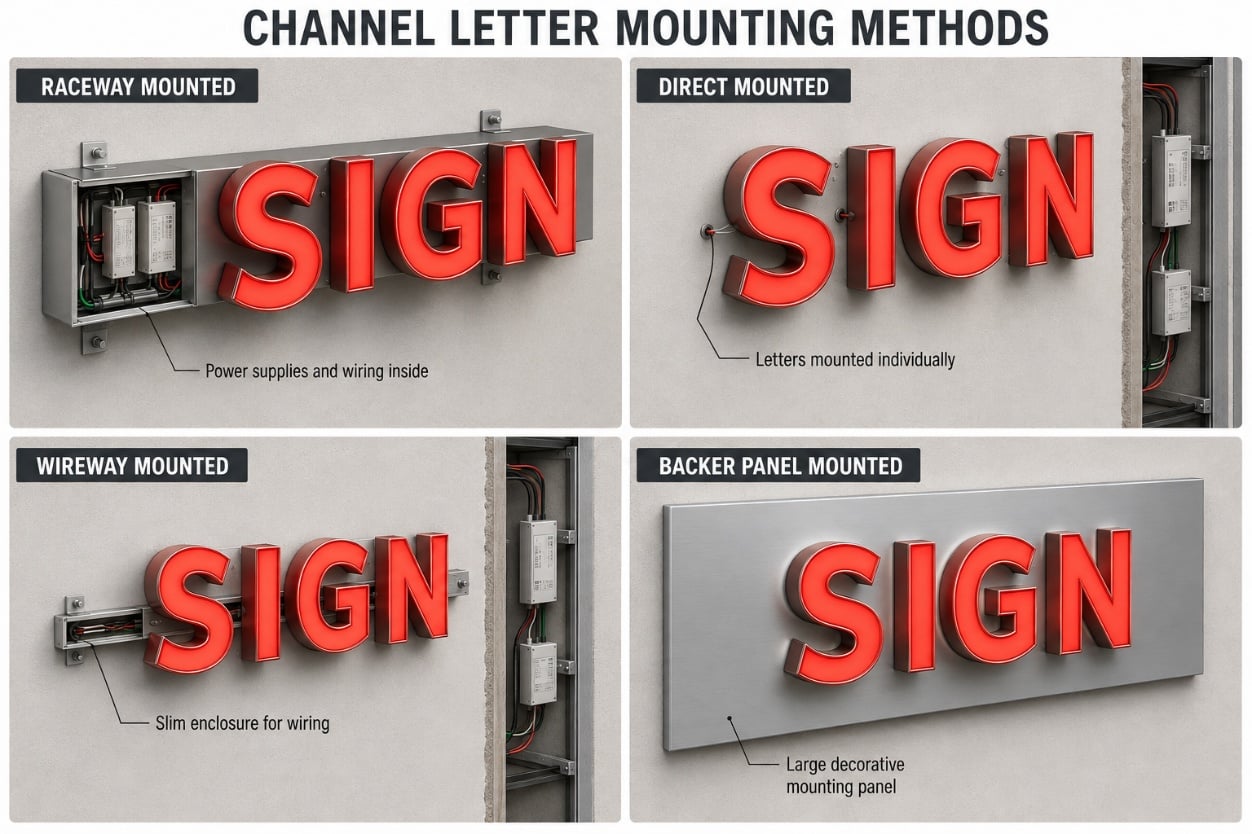
Mounting Methods at a Glance
| Assembly Method | Construction | Installation | Appearance | Best Application |
|---|---|---|---|---|
| Raceway-mounted | Letters attached to a fabricated metal box containing wiring, power supplies, and electrical connections | Complete assembly installed with relatively few wall penetrations | Raceway remains visible behind the letters but can be painted to match the wall | Fast service, simpler wiring, minimal wall penetrations |
| Direct-mounted | Each letter individually fastened directly to the building; wiring passes through the wall to power supplies behind it | Requires precise patterns and more mounting and wiring penetrations | Cleanest appearance — no visible support box | High-end storefronts and façades where appearance is the priority |
| Wireway-mounted | Letters mounted to a shallow metal enclosure that primarily contains wiring; power supplies may be installed elsewhere | Similar to raceway mounting, but the enclosure is usually slimmer | Less noticeable than a full raceway | Concealed wiring with a lower-profile mounting structure |
| Backer-panel mounted | Letters installed on a larger decorative panel that may also conceal wiring and power supplies | Completed panel and letters mounted as one coordinated assembly | Strong architectural background, improves contrast | Uneven walls, difficult surfaces, or façades requiring stronger visual impact |
Raceway-Mounted Channel Letters
A raceway is a structural aluminum enclosure installed behind the channel letters. It typically houses:
- LED power supplies
- Primary and secondary wiring
- Electrical connections
- Disconnect switches, where required
- Mounting hardware
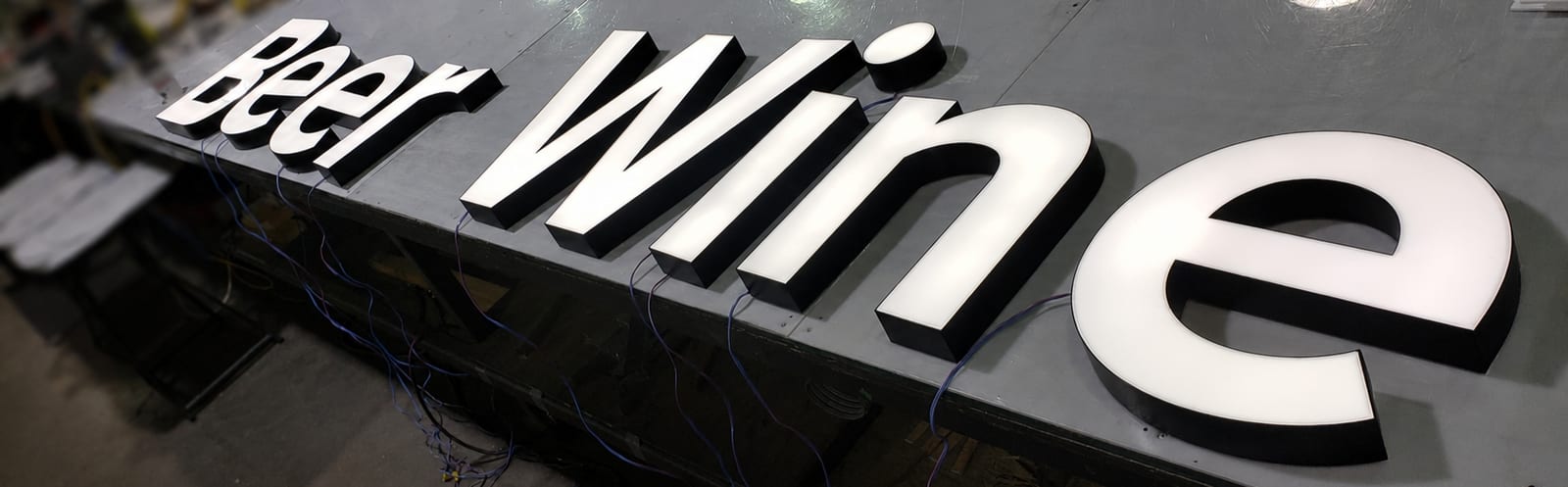
The letters are wired and secured to the raceway at the manufacturing facility, so the sign arrives as a largely completed assembly.
Advantages
- Faster and easier field installation
- Fewer penetrations through the building
- Wiring and power supplies remain accessible for service
- Suitable when access behind the wall is limited
- The entire sign can often be removed as one assembly
- Helpful for leased properties where landlords limit façade penetrations
Considerations
- The metal raceway is visible behind the letters
- It creates greater projection from the wall
- Its size and position must be coordinated with the letter layout
- It should be painted to match the façade whenever possible
Direct-Mounted Channel Letters
With direct mounting, every letter is installed separately on the wall. A full-size installation pattern identifies the mounting and electrical locations.
Advantages
- Clean, professional architectural appearance
- Letters appear individually mounted or floating
- No visible raceway behind the sign
- Better integration with premium building façades
Considerations
- More wall penetrations are normally required
- Installation takes longer
- Accurate field measurements and patterns are essential
- Servicing concealed wiring and power supplies may be more difficult
- Interior access behind the sign may be required
Wireway-Mounted Channel Letters
A wireway looks similar to a raceway but normally has a shallower profile. Its primary purpose is to organize and conceal electrical wiring rather than house all power supplies and provide the entire structural mounting system.
The terms raceway and wireway are sometimes used interchangeably, so shop drawings should clearly indicate the enclosure dimensions, power-supply location, structural function, and service-access method.
Backer-Panel Assemblies
A backer panel is wider and taller than a raceway and becomes part of the sign's visual design. It can be flat, formed, illuminated, or fabricated with multiple layers.
Advantages
- Provides excellent contrast between the letters and wall
- Covers uneven, damaged, or unsuitable façade surfaces
- Can conceal wiring and mounting points
- Allows the complete sign to be assembled and tested before delivery
- Adds architectural depth and branding opportunities
Choosing the Right Mounting Method
Choose a raceway when installation speed, service access, and fewer wall penetrations are most important.
Choose direct mounting when the cleanest appearance is the priority and access behind the wall is available.
Choose a wireway when concealed wiring is needed but a slimmer enclosure is preferred.
Choose a backer panel when the façade needs better contrast, coverage, or an additional architectural design element.
For the rest of what goes into a finished channel-letter set, see Materials Used to Make Channel Letters and the Wholesale Channel-Letter Ordering Checklist.